ESL Brains provides a wide array of grammar exercises specifically designed for intermediate English learners. These resources help students solidify their understanding of complex grammatical structures through engaging, context-rich lessons. The platform focuses on practical application, ensuring learners can use grammar accurately in real-world communication.
What is Intermediate ESL Grammar?
Intermediate ESL grammar typically covers B1 and B2 levels of the Common European Framework of Reference for Languages (CEFR). At this stage, learners move beyond basic sentence structures to master more nuanced aspects of English. This includes a deeper understanding of verb tenses, modal verbs, passive voice, conditionals, reported speech, and various other complex grammatical forms. Effective intermediate grammar exercises integrate these structures into meaningful contexts, promoting both accuracy and fluency.
The Human Side: Why These Tools Actually Matter
Before we dive into the tools, let’s talk about you for a second. If you’re reading this, you probably spend your evenings planning lessons, your weekends grading, and your Sunday nights wondering if your students are actually learning anything. You’re tired. You might be questioning whether you’re doing enough.
Here’s the truth: the anxiety you feel about keeping up with AI in education isn’t a sign you’re falling behind — it’s a sign you care. That care is what makes you a good teacher, and no tool replaces it.
What AI can do is buy you back the time you’ve been losing to admin work. The hours you’d spend creating worksheets from scratch? Those can become the hours you spend actually talking to your students, learning what they’re struggling with, and tailoring your next lesson to the human in front of you. Not the syllabus — the person.
If you’ve ever stayed up past midnight wondering if your students are bored, or felt guilty for using the same worksheet three weeks in a row because you ran out of time, this guide is for you. Not to add more to your plate, but to lift some of it off.
You deserve to teach without burning out. Let’s start.
Why are Grammar Exercises Essential for Intermediate Learners?
Grammar exercises are crucial for intermediate learners to reinforce theoretical knowledge and develop automaticity in language use. Consistent practice helps identify and correct common errors, builds confidence, and improves overall linguistic precision. Engaging exercises, particularly those based on real-world scenarios or video content, enhance retention and make the learning process more dynamic. Research indicates that structured grammar practice significantly contributes to language acquisition and proficiency development.
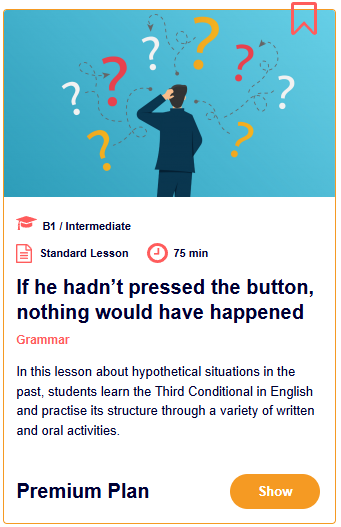
A lesson on the third conditional from ESL Brains.
What Types of Intermediate Grammar Exercises Does ESL Brains Offer?
ESL Brains offers a diverse range of intermediate grammar exercises, often integrated into full lesson plans that include video content and discussion prompts. These exercises cover a broad spectrum of grammatical topics relevant to B1 and B2 learners. Here are examples of the grammar areas and specific lessons available:
Verb Tenses and Aspects
Used to and Would:
[Back in the day… (used to vs would)](https://eslbrains.com/used-to-and-would/?partner=NQjrlXWdIQbM): Practice 'used to' and 'would' by discussing childhood and past times.
* [What life used to be like](https://eslbrains.com/lesson-set/what-life-used-to-be-like/?partner=NQjrlXWdIQbM): Focus on 'used to' and 'would' for talking about the past.
* [Life used to be different](https://eslbrains.com/life-used-to-be-different/?partner=NQjrlXWdIQbM): Teaches 'used to' for comparing past and present school life.
* **Past Perfect:**
[Past (Perfect) stories](https://eslbrains.com/lesson-set/past-perfect-stories/?partner=NQjrlXWdIQbM): Helps students understand and practice Past Perfect.
* [Pieces of the past (Past Perfect)](https://eslbrains.com/esl-lesson-on-past-perfect/?partner=NQjrlXWdIQbM): Practice Past Perfect with Past Simple through discussions on memories.
* **Future Forms (Simple, Continuous, Going to):**
[Discussing the future](https://eslbrains.com/lesson-set/discussing-the-future/?partner=NQjrlXWdIQbM): Practice Future Simple, Present Continuous, and 'going to'.
* [Will we live in a smart city?](https://eslbrains.com/will-we-live-in-a-smart-city/?partner=NQjrlXWdIQbM): Reviews future forms in the context of urban issues.
* [It will never catch on! (will for predictions)](https://eslbrains.com/future-simple-tense/?partner=NQjrlXWdIQbM): Focuses on Future Simple for predictions.
* **Present Perfect and Past Simple:**
[Using Present Perfect and Past Simple](https://eslbrains.com/lesson-set/using-present-perfect-and-past-simple/?partner=NQjrlXWdIQbM): Learn differences between the two tenses.
* [Talking about experiences using Present Perfect and Past Simple](https://eslbrains.com/lesson-set/talking-about-experiences-using-present-perfect-and-past-simple/?partner=NQjrlXWdIQbM): Practice through role-plays and discussions on life experiences.
* [Sharing experiences (Present Perfect and Past Simple)](https://eslbrains.com/sharing-experiences-present-perfect-and-past-simple/?partner=NQjrlXWdIQbM): Discuss first meetings and practice tenses.
* [Present Perfect activities](https://eslbrains.com/present-perfect-activities/?partner=NQjrlXWdIQbM): Apply Present Perfect for news, experiences, and life stories.
* [You’re never too old for great things](https://eslbrains.com/present-perfect-and-past-simple/?partner=NQjrlXWdIQbM): Learn differences and practice using both tenses.
* [Have you done it yet? Present Perfect: already, just, yet](https://eslbrains.com/present-perfect-already-just-yet/?partner=NQjrlXWdIQbM): Learn to use 'already', 'just', and 'yet' with Present Perfect.
* [Have you ever attended a silent meeting?](https://eslbrains.com/present-perfect-for-experiences/?partner=NQjrlXWdIQbM): Use Present Perfect for experiences and workplace vocabulary.
* **Present Perfect Continuous:**
[I’ve been doing it for a week and I love it!](https://eslbrains.com/present-perfect-continuous/?partner=NQjrlXWdIQbM): Combines hobbies with Present Perfect Continuous practice.
* **Present Perfect with For and Since:**
[I’ve lived here for ten years (Present Perfect + for/since)](https://eslbrains.com/present-perfect-with-for-and-since/?partner=NQjrlXWdIQbM): Learn to use 'for' and 'since' with Present Perfect.
[Storytelling](https://eslbrains.com/lesson-set/storytelling/?partner=NQjrlXWdIQbM): Revision and practice of three past tenses for storytelling.
* [Narrative tenses – using Past Simple/Continuous/Perfect for storytelling](https://eslbrains.com/narrative-tenses/?partner=NQjrlXWdIQbM): Focuses on using narrative tenses for storytelling.
* [Be a better storyteller](https://eslbrains.com/be-a-better-storyteller/?partner=NQjrlXWdIQbM): Supplements lessons on narrative tenses for improved storytelling.
* **Past Simple Revision:**
[The stories of famous entrepreneurs](https://eslbrains.com/the-stories-of-famous-entrepreneurs-past-simple-revision/?partner=NQjrlXWdIQbM): Perfect for Past Simple revision with business vocabulary.
Voice and Conditionals
Passive Voice:
[A crime has been commited](https://eslbrains.com/lesson-set/a-crime-has-been-commited/?partner=NQjrlXWdIQbM): Learn passive voice in different tenses.
* [Passive voice practice](https://eslbrains.com/passive-voice-practice/?partner=NQjrlXWdIQbM): Provides extensive passive voice practice.
* [Preventing identity theft (passive voice)](https://eslbrains.com/practise-passive-forms/?partner=NQjrlXWdIQbM): Practice passive forms in the context of online safety.
* [A new website will be created soon (passive voice)](https://eslbrains.com/esl-lesson-on-passive-structures/?partner=NQjrlXWdIQbM): Practice passive structures in different scenarios.
* [They did it for money (passive voice)](https://eslbrains.com/passive-voice/?partner=NQjrlXWdIQbM): Practice passive voice through discussions on crime.
* [How is bubble gum made (passive voice)](https://eslbrains.com/how-is-bubble-gum-made/?partner=NQjrlXWdIQbM): Use passive voice to talk about processes.
[What if cars could fly? (hypothetical situations)](https://eslbrains.com/hypothetical-situations/?partner=NQjrlXWdIQbM): Master Second Conditional with videos and speaking tasks.
* [What would happen if you quit texting for a week? (Second Conditional)](https://eslbrains.com/quit-texting-for-a-week-second-conditional/?partner=NQjrlXWdIQbM): Discover and practice Second Conditional in the context of texting.
* **Third Conditional:**
[If he hadn’t pressed the button, nothing would have happened](https://eslbrains.com/if-he-hadnt-pressed-the-button-third-conditional/?partner=NQjrlXWdIQbM): Learn and practice Third Conditional for hypothetical past situations.
Pronouns, Modals, and Other Structures
Reflexive and Reciprocal Pronouns:
[Do it yourself!](https://eslbrains.com/do-it-yourself/?partner=NQjrlXWdIQbM): Practice reflexive and reciprocal pronouns.
* **Modal Verbs (Permission, Obligation, Advice, Prohibition, Past Ability):**
[They should be allowed to do it! (modal verbs)](https://eslbrains.com/lesson-set/they-should-be-allowed-to-do-it-modal-verbs/?partner=NQjrlXWdIQbM): Practice modal verbs of permission, obligation, and advice.
* [Old enough to decide](https://eslbrains.com/modal-verbs-of-permission-and-obligation/?partner=NQjrlXWdIQbM): Practice modal verbs related to age limits.
* [That’s how it was (past ability and obligation)](https://eslbrains.com/expressing-past-ability-and-obligation/?partner=NQjrlXWdIQbM): Explore phrases for past ability and obligation.
* [What are your travelling tips? (modal verbs)](https://eslbrains.com/travelling-tips-modal-verbs/?partner=NQjrlXWdIQbM): Practice 'can', 'have to', 'should' for travel tips.
* **Questions without Auxiliaries:**
[What happened? (questions without auxiliaries)](https://eslbrains.com/what-happened-questions-without-auxiliaries/?partner=NQjrlXWdIQbM): Explore and practice questions without auxiliaries.
* [Questions no one knows the answers to](https://eslbrains.com/questions-no-one-knows-the-answers-to/?partner=NQjrlXWdIQbM): Exercises on indirect and direct questions.
* **Quantifiers:**
[Practising quantifiers in different contexts](https://eslbrains.com/lesson-set/practising-quantifiers-in-different-contexts/?partner=NQjrlXWdIQbM): Practice quantifiers in discussions about job satisfaction.
* [How about a little improvement?](https://eslbrains.com/how-about-a-little-improvement/?partner=NQjrlXWdIQbM): Practice quantifiers in various contexts like work conditions.
* **So and Such:**
[It’s such a lovely place! (so and such)](https://eslbrains.com/its-such-a-lovely-place-so-and-such/?partner=NQjrlXWdIQbM): Practice 'so' and 'such' structures in travel discussions.
* **Stative Verbs:**
[The things we want and the things we need (stative verbs)](https://eslbrains.com/the-things-we-want-and-the-things-we-need-stative-verbs/?partner=NQjrlXWdIQbM): Practice stative and active verbs.
* **Question Tags:**
[Do you enjoy quiz shows? (question tags)](https://eslbrains.com/question-tags-lesson/?partner=NQjrlXWdIQbM): Practice using question tags to express uncertainty.
* **Gerunds and Infinitives:**
[Being unproductive (uses of gerund)](https://eslbrains.com/being-unproductive-uses-of-gerund/?partner=NQjrlXWdIQbM): Practice using gerunds to talk about leisure activities.
* [Friends will be friends (gerunds and infinitives)](https://eslbrains.com/friends-gerunds-and-infinitives/?partner=NQjrlXWdIQbM): Discover different verb patterns and practice gerunds and infinitives.
* **Relative Clauses (Defining/Non-defining):**
[Famous people (non-defining relative clauses)](https://eslbrains.com/famous-people-non-defining-relative-clauses/?partner=NQjrlXWdIQbM): Learn and practice defining and non-defining relative clauses.
* **Articles:**
[Renting a flat (articles)](https://eslbrains.com/renting-a-flat-articles/?partner=NQjrlXWdIQbM): Learn how to use articles ('a/an', 'the', no article).
* **Reported Speech:**
[You said it was OK (reported speech)](https://eslbrains.com/you-said-it-was-ok-reported-speech/?partner=NQjrlXWdIQbM): Learn and practice reported speech through discussions on misunderstandings.
* **Indefinite Pronouns:**
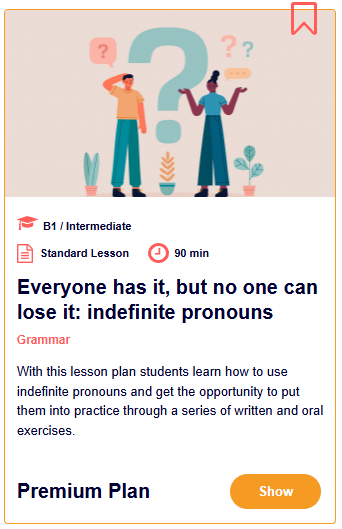
[Everyone has it, but no one can lose it: indefinite pronouns](https://eslbrains.com/indefinite-pronouns/?partner=NQjrlXWdIQbM): Learn and practice using indefinite pronouns.
* **Expressing Cause and Effect:**
[Today’s teens are going through a lot (cause and effect)](https://eslbrains.com/b1-b2-expressing-cause-and-effect/?partner=NQjrlXWdIQbM): Learn and practice expressing cause and effect.
* **Comparisons:**
[Printed books vs e-books – making comparisons](https://eslbrains.com/bookwars-making-comparisons/?partner=NQjrlXWdIQbM): Teach how to make comparisons and discuss advantages/disadvantages.
* **Giving Advice and Suggestions:**
[Giving advice and making suggestions](https://eslbrains.com/extra-worksheet-giving-advice/?partner=NQjrlXWdIQbM): Focuses on giving advice and making suggestions.
* **Vocabulary and Word Building (Suffixes):**
[Ready to go paperless?](https://eslbrains.com/lesson-on-suffixes-ful-and-less/?partner=NQjrlXWdIQbM): Work on word building with suffixes ‘-ful’ and ‘-less’.
* **Contextual Language Use (TED Talk Lessons):**
[Technology and the future](https://eslbrains.com/lesson-set/technology-and-the-future/?partner=NQjrlXWdIQbM): Learn phrases to speculate about the future.
* [For these women, reading is a daring act](https://eslbrains.com/for-these-women-reading-is-a-daring-act/?partner=NQjrlXWdIQbM): Discuss gender inequality and education through a TED Talk.
An ESL Brains lesson on indefinite pronouns.
How Do ESL Brains Exercises Help Improve Grammar?
ESL Brains exercises facilitate grammar improvement through a multi-faceted approach. Lessons often begin with engaging video content or real-life scenarios, providing a natural context for grammar points. Students then engage in various activities, including gap-fills, sentence transformations, role-plays, and discussions, which require active application of the target grammar. This active learning methodology, combined with clear explanations and ample practice opportunities, helps learners internalize grammar rules and use them confidently in both spoken and written English.
Where Can I Find ESL Brains Intermediate Grammar Exercises?
All the mentioned intermediate grammar exercises are available directly on the ESL Brains website. Each lesson page provides detailed descriptions of the grammar points covered, the activities included, and the target CEFR level. Users can navigate the site to find specific grammar topics or explore lesson sets that combine multiple grammar points for comprehensive practice.
ESL Brains hub
ESL Brains reviewed: the complete guide for teachers
The main ESL Brains hub covers pricing in 2025, what teachers actually use it for, honest pros and cons, ESL Brains vs Teach-This, and the best alternatives — so you can decide if it's the right fit for your adult and business English classes.